
Smart Vending Solutions for Manufacturing Facilities
Table of Contents
Why Smart Vending Is Replacing the Breakroom Status Quo
Industrial Vending Machine Benefits for Manufacturing Teams
Less Downtime, More Output
Real-Time Data on What Workers Actually Buy
Automated Inventory Management for Manufacturing Facilities
How Vending Data Reaches Your ERP, WMS, or CMMS
What to Ask Before You Sign
PPE and MRO: The Same Plumbing, Different Rules
Vending Machine Maintenance Best Practices for Plant Managers
What Smart Vending Solutions Cost (and What You Actually Get)
Security, Safety, and Compliance on the Plant Floor
Access Control: Badge, PIN, and Biometric Options
Placement, Egress, and OSHA-Aligned Safety
Sustainability and Energy Metrics
What Compliance Teams Typically Ask For
Conclusion
Frequently Asked Questions
Last Updated: October 4, 2026
Why Smart Vending Is Replacing the Breakroom Status Quo
The industrial vending machine market is projected to grow from $3.6 billion in 2025 to $9.4 billion by 2035, according to Spherical Insights market forecast. That growth isn't driven by snack cravings.

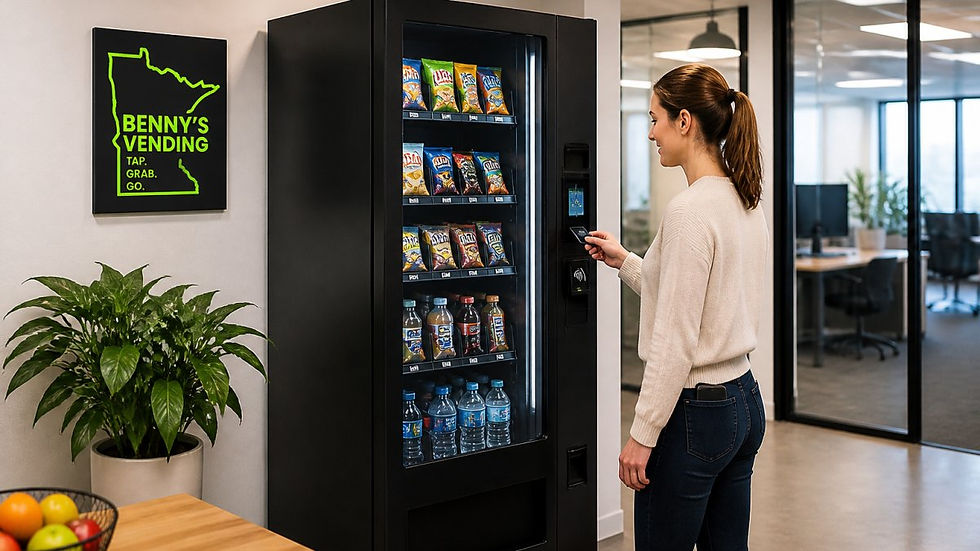
Smart vending solutions for manufacturing facilities replace that status quo with something closer to a managed retail system: real-time inventory tracking, cashless payments, and restocking driven by actual usage data rather than a route driver's best guess.
The shift matters because downtime compounds. A machine that jams at 2 a.m. doesn't just inconvenience one shift; it pulls workers off the line in small increments all week.
Industrial Vending Machine Benefits for Manufacturing Teams
Industrial vending machine benefits extend well past convenience. The core value is measurable: fewer interruptions, better product availability, and data that tells you what your workforce actually consumes.
Less Downtime, More Output
Every trip off-site for a snack or drink is unpaid time you're still paying for. On-site micro-markets and smart vending keep workers inside the building, cutting the length and frequency of those breaks. For plants running tight shift schedules, that recovered time adds up across dozens of employees.
Real-Time Data on What Workers Actually Buy
Remote inventory monitoring is where smart vending separates itself from a standard machine. Operators get telemetry showing which slots sell out, which products stall, and what time of day demand peaks. That data feeds automated replenishment, so you stop stocking based on assumptions.
Problem | Smart Vending Fix | Practical Impact |
Machine runs empty mid-shift | Real-time inventory alerts | Restocking triggered before stockout |
Wrong products stocked | Sales data by slot and time | Menu adjusted to actual demand |
Cash-only, exact change needed | Cashless payment systems | Faster transactions, fewer jams |
No visibility into usage | Cloud-based management dashboard | Data for budgeting and planning |
Pro Tip Watch your 2 a.m. to 6 a.m. sales data separately. Night shifts often want different products than day shifts, and a single shared planogram usually under-serves both.
Automated Inventory Management for Manufacturing Facilities
Automated inventory management for manufacturing turns vending from a passive amenity into a tracked supply channel. The system records every transaction, flags low stock, and pushes replenishment orders automatically. The part most vendor pages skip is how that data actually reaches the systems your plant already runs on.
How Vending Data Reaches Your ERP, WMS, or CMMS
A smart vending machine is, at its core, a small transactional database. Every dispense event carries a timestamp, a SKU, a user ID (if access control is enabled), a payment method, and a machine location.
There are three common integration patterns, and they differ in effort and latency:
Flat-file or CSV export on a schedule. The vending management platform drops a nightly or hourly file to an SFTP location, and your ERP or WMS ingests it as a standard inventory receipt or issue transaction. Lowest technical lift, but data is stale by hours.
REST API or webhook push. The vending platform posts each transaction to an endpoint your IT team controls, which writes it into the ERP, WMS, or a middleware layer. Near real-time, and the pattern most commonly used when vending feeds a CMMS for MRO parts consumption.
Native connector. Some vending management platforms ship pre-built connectors for major ERP and WMS products. Fastest to stand up, but you inherit whatever field mapping the vendor chose.
For a plant manager, the practical takeaway is that vending data can plug into existing inventory workflows rather than living in a separate spreadsheet. That integration point is where most traditional setups fall short, and where the choice of vending partner quietly determines whether you get a data feed or a data silo.
What to Ask Before You Sign
Before committing to a platform, get written answers to four questions:
What export formats and APIs are supported, and is there a per-call or per-record fee?
Can transactions be tagged with a cost center, work order, or department code so they post to the right GL account?
How are SKU numbers mapped between the vending catalog and your ERP item master, manual, bulk upload, or automatic?
What happens to historical data if you switch vendors?
A vending partner that can't answer these in writing is selling you a machine, not an inventory system.
PPE and MRO: The Same Plumbing, Different Rules
LabPro Inc. deployed smart vending for PPE and laboratory consumables, using automated tracking and controlled access to manage high-value items. Fastenal's FASTVend system does something similar for MRO supplies, giving facilities 24/7 access while cutting procurement waste.
The same logic applies whether you're dispensing nitrile gloves, cutting tools, or calibration gases. What changes is the access rule: PPE and MRO items typically require badge authentication so consumption can be attributed to a person or a job, while breakroom snacks usually don't.
Pro Tip If your ERP already tracks MRO consumption by work order, ask the vending vendor to write the work order number into the transaction record at the point of dispense. Retrofitting that attribution after the fact is expensive.
According to MarketsandMarkets industrial vending research, industrial vending machines are increasingly adopted in manufacturing facilities because they reduce energy consumption and improve cost-effectiveness in inventory management. The mechanism is straightforward: less manual counting, fewer emergency runs, and shrinkage you can actually see, provided the data lands somewhere your team already looks.
Vending Machine Maintenance Best Practices for Plant Managers
Vending machine maintenance best practices come down to prevention over repair. The machines that stay online longest are the ones monitored continuously, cleaned on schedule, and serviced before a failure takes them down.
Effective management of smart vending fleets requires centralized tracking to monitor operational status and location in real time, per Device Insight smart vending whitepaper. That means a dashboard, not a clipboard.
A practical maintenance rhythm for a manufacturing floor:
Check telemetry alerts daily for fault codes and low-stock flags
Wipe down touchscreens and dispensing areas weekly
Test cashless payment terminals and network connectivity quarterly
Watch Out Ignoring a recurring "sold out" flag on a high-traffic slot doesn't just lose that sale. It trains workers to stop checking the machine, and once they stop, the whole amenity loses its value.
What Smart Vending Solutions Cost (and What You Actually Get)
Smart vending solutions cost depends on machine type, product mix, and service terms, and there's no single number that fits every facility.
What you get for that cost is the part worth focusing on. Cashless payment systems and dynamic pricing are identified as the most profitable investment category for 2026, according to VendSoft vending investment analysis.
At Benny's Vending, we offer zero-cost and no-contract options, which removes the capital outlay question entirely. We handle installation, maintenance, and restocking, so the facility's only job is giving us floor space.
Security, Safety, and Compliance on the Plant Floor
Security and compliance are where generic vending advice quietly fails. A machine sitting on a production floor has to meet the same standards as everything around it, and that's a detail most vendor pages skip. This section covers the three areas that actually get a vending rollout approved, or blocked, by a plant's safety, security, and sustainability teams.
Access Control: Badge, PIN, and Biometric Options
Access control is the feature that turns a vending machine from a breakroom amenity into a controlled supply point. The three mechanisms in common use are:
Badge or RFID reader. The machine reads the same employee badge used for door access, so credential management stays with your existing security team. This is the most common choice in manufacturing because it requires no new enrollment.
PIN entry. A numeric code assigned per employee or per role. Cheap to deploy, but codes get shared, so it's best for low-value items.
Biometric (fingerprint or palm). Highest assurance and no credential to lose, but it requires enrollment, raises privacy considerations, and adds cost per reader.
Badge-gated dispensing lets you restrict high-value consumables to specific roles while keeping general snacks open to everyone. That single feature is often what makes a smart vending rollout defensible to a compliance team, especially when the items being dispensed are regulated, serialized, or subject to audit.
Placement, Egress, and OSHA-Aligned Safety
On the safety side, machines placed near walkways or emergency exits create real hazards. Placement should keep aisles clear and respect egress paths. A few practical rules that align with standard OSHA walking-working-surface and exit-route expectations:
Keep at least the width of a forklift aisle clear in front of any machine so a worker standing at the touchscreen isn't a pedestrian hazard.
Never place a machine where it blocks or narrows an exit route, even temporarily during restocking.
Anchor tall machines to the floor or wall in seismic zones and in areas with vehicle traffic.
Route power cords so they don't cross walkways; use cord covers or hardwired connections.
For food and beverage, hygiene and allergen labeling matter as much as the hardware. Products need clear date marking, and machines should be cleaned on a documented schedule, the same sanitation discipline you'd apply to any food-contact surface on the floor.
Sustainability and Energy Metrics
Manufacturing facilities operate under ESG targets that most vending vendors ignore entirely. If your plant reports energy intensity or Scope 2 emissions, a vending fleet is a small but countable line item. Ask vendors for:
Annual kWh consumption per machine, ideally broken out by cooling versus idle draw.
Whether the machine uses LED lighting and variable-speed or on-demand compressors.
Refrigerant type and global warming potential for any cooled unit.
Whether the management platform can export energy data on a schedule that matches your reporting cadence.
A fleet of a dozen machines won't move your plant's overall footprint, but it will show up in an audit, and a vendor who can't produce the numbers is a vendor who'll cost your sustainability team a week of manual estimation.
Watch Out If a machine dispenses regulated substances, controlled items, or anything subject to chain-of-custody rules, confirm in writing that the access log is exportable and retained for the period your compliance team requires. A machine that gates access but doesn't log it is a liability, not a control.
What Compliance Teams Typically Ask For
In practice, the questions that stall a vending rollout are predictable: Who can access what? Where is the access log stored, and for how long? What's the cleaning schedule, and who signs off? What's the machine's power draw? Get answers to those four before the first machine arrives, and the approval process moves quickly.
Conclusion
The hardest part of modernizing a breakroom isn't the technology; it's finding a partner who handles installation, restocking, and service without locking you into a contract. Benny's Vending builds AI-powered smart stores and micro-markets with real-time inventory tracking, contactless payment, and customizable digital displays, all managed end to end so your team never has to think about it. Request a machine and give your workforce a breakroom that actually keeps up.
Frequently Asked Questions
How do smart vending solutions improve efficiency in manufacturing plants?
Smart vending machines reduce the time workers spend away from the line by placing snacks, drinks, and supplies directly on the floor. Real-time inventory tracking means machines rarely run empty, so employees don't waste a break walking to an out-of-stock unit. The global industrial vending machine market is projected to grow from $3.9 billion in 2026 to $7.5 billion by 2033 at a 9.7% CAGR, according to Grand View Research, driven largely by manufacturers adopting this model to cut downtime and improve inventory control.
What is the ROI of installing smart vending solutions in a manufacturing facility?
ROI comes from three places: reduced employee downtime, lower product waste through automated inventory management, and fewer emergency restocking trips. For food and beverage vending, the gains are smaller per transaction but compound across a large workforce. Benny's Vending offers zero-cost, no-contract options so facilities can test the model without capital outlay.
How does real-time inventory tracking reduce vending downtime?
Traditional vending relies on route drivers guessing when to restock. Smart machines transmit live inventory data to a cloud-based management platform, so restocking happens before shelves go empty. Device Insight notes that effective management of smart vending fleets requires centralized tracking to monitor operational status and location in real time. For a manufacturing facility running three shifts, that means a machine on the night shift gets refilled on schedule instead of sitting empty until the next route visit.
Can smart vending machines be customized for PPE and industrial supplies?
Yes. Industrial vending machines are increasingly used for MRO supplies, PPE, and high-value consumables, not just snacks. For manufacturing facilities, this means one machine can dispense safety glasses, gloves, and cutting tools alongside employee refreshments, with access controls that prevent over-issuing and track usage by shift or department.
Request a Machine


Comments