
Benefits of Contactless Payment Vending Machines

Table of Contents
How Cashless Vending Machine Technology Works
NFC, Mobile Wallets, and Tap-to-Pay Explained
Key Benefits of Contactless Payment Vending Machines for Businesses
Faster Transactions and Shorter Wait Times
Higher Sales and Revenue Growth
How to Increase Vending Machine Revenue with Contactless Payments
Real-Time Data and Inventory Tracking
Vending Machine Security Standards and Fraud Prevention
What PCI DSS Actually Requires on a Vending Machine
The Fraud Vectors That Actually Hit Vending Machines
Cash Handling Risk: The Quiet Savings
Transaction Fees and Hardware Integration: What Operators Miss
Maintenance, Connectivity, and Sustainability Considerations
Connectivity Failure Modes and How to Diagnose Them
A Practical Maintenance Cadence
The Sustainability Case, Measured
Where the Market Is Heading
Conclusion
Frequently Asked Questions
Last Updated: September 27, 2026
How Cashless Vending Machine Technology Works
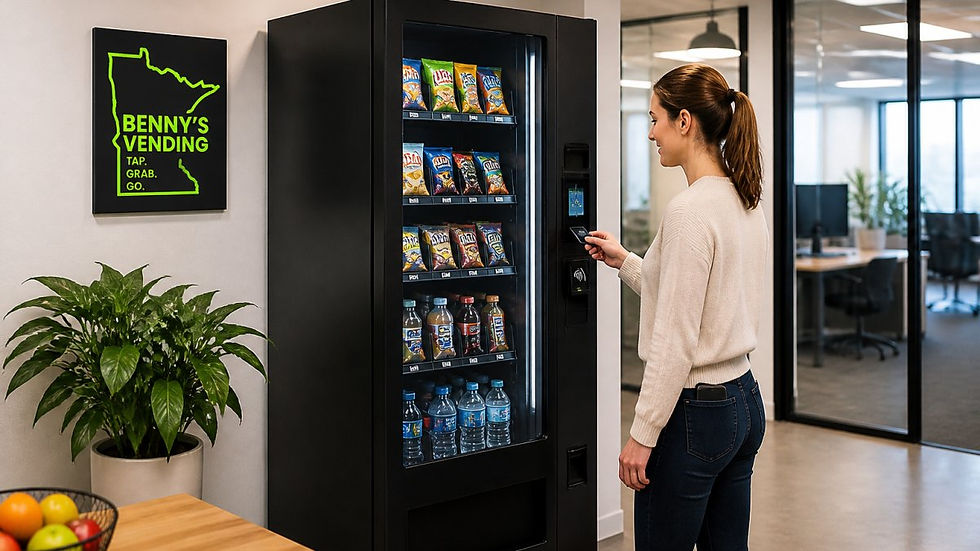
Contactless payment vending is the system that lets a customer pay for a snack or drink by tapping a card or phone against a reader, with no cash and no physical contact. The reader, the network, and the machine's software complete the sale in seconds. That speed is the reason cashless vending now dominates unattended retail.

NFC, Mobile Wallets, and Tap-to-Pay Explained
NFC technology is the short-range wireless standard that lets a payment card or phone communicate with a reader when held a few centimeters away. The reader sends a payment request through a digital payment gateway, and the transaction clears in seconds. This seamless exchange highlights why NFC payment technology has become the preferred standard for modern vending, offering a distinct advantage over traditional card readers.
An NFC-enabled POS terminal mounted on the machine face
A cellular or Wi-Fi connection for payment processing
Secure encryption that protects card data in transit
A cloud-based dashboard for remote sales and inventory visibility
Key Benefits of Contactless Payment Vending Machines for Businesses
The benefits of contactless payment vending machines come down to two measurable outcomes: faster transactions and higher revenue. Everything else, from hygiene to data, flows from those two.
Faster Transactions and Shorter Wait Times
A contactless transaction takes 3-5 seconds, roughly 30% faster than traditional payment methods, according to Connect Vending's 2026 analysis. In a breakroom with 40 people on the same 15-minute break, that difference is the gap between a smooth line and a frustrated one.
Higher Sales and Revenue Growth
Cashless machines sell more. According to PaymentsJournal's 2025 vending payment data, 71% of all vending machine sales were cashless, a 17% increase over 2023. Operators consistently report higher average transaction values after adding card readers, because customers buy the full snack-and-drink combination instead of counting coins.
Key Takeaway The revenue gain from contactless payment vending is not just about more transactions. It is about larger ones, since customers who tap spend more per visit than customers hunting for exact change.
How to Increase Vending Machine Revenue with Contactless Payments
The fastest way to increase vending machine revenue is to pair contactless payment with real-time data, then stock what the data says people actually buy. Guessing at product mix is where most operators lose money.
Real-Time Data and Inventory Tracking
Real-time telemetry changes how a route gets planned. Instead of visiting every machine on a fixed schedule, operators see which machines are low and restock only those. Business Research Insights' 2026 vending market report notes that contactless systems let operators collect data for targeted marketing and optimize product selection based on real consumer behavior.
The practical gains show up in three places:
Inventory tracking that flags a sold-out row before a customer finds it
Purchase frequency patterns by day and shift
Revenue optimization through product placement and pricing tests
Vending Machine Security Standards and Fraud Prevention
Payment security in vending rests on the same encryption standards used across retail card processing, but the way those standards show up inside a vending machine is different from a checkout lane. Understanding the mechanics is what separates an operator who can answer a customer complaint from one who cannot.
What PCI DSS Actually Requires on a Vending Machine
The PCI Security Standards Council sets PCI DSS as the baseline for any device that stores, processes, or transmits card data. For vending, the practical requirements land in four places:
Encryption at the point of capture. The card reader encrypts the primary account number the moment the card or phone is tapped, so the machine's controller never sees raw card data.
Tokenization. Most modern readers replace the card number with a one-time token before the transaction leaves the machine. If the network is intercepted, the token is useless outside that single sale.
Segmented architecture. The payment module is isolated from the machine's operating software, so a firmware bug in the vending controller cannot expose payment data.
Attestation. Operators using a validated payment provider inherit that provider's PCI attestation rather than building their own compliance program from scratch.
The Fraud Vectors That Actually Hit Vending Machines
Card skimming gets the headlines, but the fraud patterns that show up in unattended retail are more mundane:
Card testing. A stolen card number is run through a low-dollar vending purchase to see if it still works. Because vending transactions are small, they often slip past issuer fraud rules. Real-time velocity monitoring at the gateway is the main defense.
Chargeback abuse. A customer disputes a $2.50 snack purchase they actually made. Digital records with a timestamp, machine ID, and item selection make these disputes winnable, but only if the operator retains the transaction log.
Physical reader tampering. A skimmer overlay glued onto the reader face. Tamper-evident seals and periodic route inspections catch this; remote monitoring alone will not.
Refund and vend-fail abuse. A customer claims the machine took payment but dropped nothing. Telemetry that logs a successful vend versus a failed one resolves most of these in the operator's favor.
Cash Handling Risk: The Quiet Savings
Cashless systems also reduce a quieter risk: cash handling. Machines that hold no bills are machines that cannot be broken into for them, and route drivers no longer carry collections between stops. That removes both the theft exposure and the labor of counting, reconciling, and depositing cash.
Risk | Cash Machine | Contactless Machine |
Theft from cash box | High | Eliminated |
Card data interception | N/A | Blocked by encryption and tokenization |
Card testing / skimming | N/A | Mitigated by gateway velocity rules and tamper seals |
Transaction disputes | Manual, slow | Digital records with machine ID and timestamp |
Restock visibility | Blind | Real-time dashboard |
Key Takeaway Security in contactless vending is not a feature you buy once. It is a stack: encrypted reader, tokenized gateway, tamper-evident hardware, and retained transaction logs. Missing any one layer is where losses happen.
Transaction Fees and Hardware Integration: What Operators Miss
Two costs decide whether a contactless upgrade pays for itself: per-transaction processing fees and hardware compatibility. Most sales-focused guides skip both, which is why operators get surprised later.
Does the machine support a retrofit reader, or does it need a full controller replacement?
Is there reliable cellular or Wi-Fi coverage at the machine's location?
Does the payment provider's dashboard integrate with your existing reporting?
Are processing fees flat, tiered, or percentage-based?
Watch Out A common mistake is ordering readers before confirming the machine's controller can support them. The result is a stalled install and a machine that sits offline while you wait on a replacement part.
Maintenance, Connectivity, and Sustainability Considerations
Most guides stop at "remote monitoring reduces downtime." That is true but useless when a machine is offline at 7 a.m. and the breakroom is filling up. This section covers the failure modes you will actually hit, how to diagnose them, and why the sustainability case is stronger than a generic carbon-footprint claim.
Connectivity Failure Modes and How to Diagnose Them
A contactless machine that loses its connection cannot process payments, so connectivity is a revenue-critical system, not an IT afterthought. The four failure modes operators see most often:
Cellular signal loss. Common in basement breakrooms, metal-clad warehouses, and parking garages. Symptom: the reader powers on but transactions time out. Fix: an external antenna, a signal booster, or a switch to Wi-Fi if the site has it.
Wi-Fi credential drift. The site changes its router or password and the machine silently drops off. Symptom: the machine works for cash but not card. Fix: a documented re-provisioning procedure and a monitoring alert tied to the machine's last successful transaction.
Reader firmware mismatch. A gateway updates its protocol and an older reader stops completing handshakes. Symptom: intermittent declines that are not tied to any single card. Fix: confirm the reader is on the provider's supported firmware list and schedule updates during low-traffic windows.
Power interruption at the machine. A tripped breaker or a loose plug takes the reader down even when the network is fine. Symptom: no lights on the reader. Fix: a battery backup on the payment module, or at minimum an alert that distinguishes "offline" from "no power."
A Practical Maintenance Cadence
Remote diagnostics catch software and connectivity issues, but they do not clean a bill validator, replace a worn reader face, or notice a skimmer overlay. A route-based inspection cadence still matters:
Every visit: wipe the reader face, check the tamper seal, confirm the display is legible, and verify the machine completed a test transaction.
Monthly: inspect cabling and mounting hardware, review the transaction log for unusual decline patterns, and confirm firmware is current.
Quarterly: test the backup power path, review gateway fee statements against expected volume, and audit product planogram against real-time sales data.
The Sustainability Case, Measured
The sustainability argument for cashless vending is often stated as a vague carbon-footprint benefit. The measurable version is more useful:
Fewer restock trips. Real-time inventory data lets operators skip machines that are still full. Fewer miles driven per route means less fuel burned and less vehicle wear.
No cash logistics. Eliminating coin and bill handling removes the armored-car or bank-run trips that cash routes require.
Digital receipts. Customers who want a receipt get it by email or app instead of a printed slip, cutting paper consumption across the fleet.
Longer hardware life. Remote diagnostics catch failing components before they cascade, which extends the service life of the machine and defers the embodied carbon of a replacement.
Where the Market Is Heading
The market is growing for exactly these reasons. Dataintelo's 2026 market forecast projects a 14.2% compound annual growth rate for the smart contactless vending market through 2034. Growth is real, though adoption rates have begun to stabilize after several years of steep increases, per the Cantaloupe Micropayment Trends Report.
Watch Out The most expensive connectivity mistake is treating an offline machine as a low-priority ticket. Every hour a contactless machine is down, it is not just losing sales; it is training customers to walk to the next option and not come back.
Conclusion
The hardest part of upgrading to contactless payment vending is not the technology. It is choosing a partner who handles installation, maintenance, and restocking to ensure the machines simply work. Benny's Vending provides AI-powered smart stores and vending with real-time inventory tracking, contactless payment technology, and customizable digital displays, all under zero-cost, no-contract options. Request a machine from Benny's Vending and give your team a tap-and-go breakroom that never runs dry.
Frequently Asked Questions
How do contactless payment vending machines work?
Contactless payment vending machines use NFC technology and digital payment gateways to process transactions when a customer taps a card or mobile wallet near the reader. The system authorizes payment in 3-5 seconds, then dispenses the product. Cloud-based dashboards track every sale in real time, giving operators remote visibility into inventory and revenue without cash handling.
Do contactless vending machines increase sales?
Yes. Industry data shows 71% of all vending machine sales were cashless in 2025, a 17% increase from 2023. Contactless transactions take 3-5 seconds, roughly 30% faster than traditional methods, which reduces friction and boosts purchase frequency. Operators consistently report higher average transaction values after installing contactless readers.
Are contactless vending machines secure?
Contactless systems use secure encryption and tokenization to protect payment data, meeting the same security standards as retail POS terminals. They also reduce theft risk by eliminating cash on site. Remote monitoring alerts operators to unusual activity, and digital transaction logs create an auditable record for every purchase. Vending machine security standards continue to evolve as adoption grows.
Can I retrofit my existing vending machines with contactless readers?
Many older machines can be retrofitted with aftermarket contactless payment readers, though compatibility depends on the machine's age, model, and wiring. Newer smart vending machines often come with integrated card readers and cloud connectivity built in. If you are evaluating options, ask your vending provider whether your current equipment supports an upgrade or if a machine replacement makes more sense.
Request a Machine


Comments