
Zero Cost Vending Machine Service Options: 2026 Guide
Table of Contents
How Zero Cost Vending Machine Service Options Work
What Providers Supply Under a No-Cost Arrangement
The Full-Service Vending Machine Program: Equipment, Delivery, and Installation
Vending Machine Service Fees: What Zero Cost Does and Does Not Cover
Vending Machine Service Contract Terms to Review Before You Sign
Vending Machine Contract Cancellation and Exit Options
Comparing Zero Cost Vending Machine Service Options Side by Side
How to Set Up a Zero Cost Vending Service at Your Location
Frequently Asked Questions
Last Updated: October 15, 2026
How Zero Cost Vending Machine Service Options Work
The U.S. vending machine market was valued at $21.9 billion in 2024 and is projected to reach $30.27 billion by 2033, according to K and E Vending Technologies' vending industry statistics. That growth is fueled partly by zero cost vending machine service options, which let a location host a machine without buying equipment or paying service charges. At Benny's Vending, we run this model every day: the operator owns the machine, and the location provides only the space and a power outlet.
A zero cost vending machine service is a full-service arrangement in which the provider supplies, installs, stocks, and maintains the equipment at no upfront charge to the business. The provider recovers its investment through product sales rather than invoices. That single distinction explains nearly every term you will see in a contract.

What Providers Supply Under a No-Cost Arrangement
Under a typical no-cost service, the provider covers the machine, delivery, installation, restocking, and repairs. Vending.com's full-service program description states that its service comes at no cost and includes machines stocked with the location's choice of drinks and snacks. In practice, that means the location's only obligations are floor space, a standard power connection, and reasonable access for route drivers.
What most guides miss is that "no cost" describes the location's invoice, not the total economics. The machine still has to earn its keep.
The Full-Service Vending Machine Program: Equipment, Delivery, and Installation
A full-service vending machine program bundles equipment, delivery, installation, stocking, and maintenance into one agreement. You sign once; the provider handles the rest. For offices without staff to manage a machine, this is the only version of vending that works.
Equipment ranges widely. A Swoop Funding guide to starting a vending business puts machines anywhere from $50 for used units to $10,000 for advanced models, which tells you why ownership is not for everyone. Under a no-cost program, that capital outlay sits with the provider.
Setup usually follows a short sequence:
Site survey to confirm foot traffic and power access
Machine selection matched to your space and headcount
Delivery and installation, typically within days of approval
Initial stocking and a launch check on payment systems
Vending Machine Service Fees: What Zero Cost Does and Does Not Cover
Zero cost vending typically covers equipment, installation, delivery, restocking, and repairs, but it does not mean the arrangement is free of every possible charge. Barrett Vending's explanation of free vending services notes that the provider owns the machine and earns back its cost through product sales. That is the trade: no invoices, but the provider sets product pricing and keeps the sales revenue.
The clearest way to evaluate any offer is to separate what the provider absorbs from what the location still pays. Most practitioners find the split looks like this:
Cost Item | Usually Covered by Provider | Usually Borne by Location |
Machine and hardware | Yes | No |
Delivery and installation | Yes | No |
Routine restocking | Yes | No |
Repairs and parts | Yes | No |
Electricity to run the machine | No | Yes |
Network or connectivity for cashless readers | Sometimes | Sometimes |
Product purchases by employees | No | Yes (at retail price) |
Custom branding or wraps | Sometimes | Sometimes |
Machine relocation mid-contract | No | Yes |
Damage beyond normal wear | No | Yes |
Electricity is the most overlooked line. A standard refrigerated snack and beverage machine draws roughly the same power as a residential refrigerator, so the location's utility bill rises even though no invoice arrives from the vending company. Cashless readers also need a data connection, and some providers bundle that cost while others expect the location to supply Wi-Fi.
Vending machine service fees can still appear in specific situations:
Minimum sales thresholds that trigger a service charge if unmet
Fees for moving a machine to a new address mid-contract
Charges for damage beyond normal wear
Restocking fees if you request non-standard products
Early termination fees if you exit before the term ends
Watch Out The most common mistake is assuming "no cost" means "no obligations." If your location generates too little foot traffic to hit a minimum sales threshold, some providers pass the shortfall back to you. Ask for the threshold in writing before you sign.
Owners who buy their own equipment face different math. A SandStar guide to the snack vending business suggests budgeting $100 to $400 per machine annually for parts and service. That figure is a useful benchmark: it is roughly what a no-cost provider absorbs on your behalf, and it is the number to weigh against the electricity and connectivity costs you keep.
Pro Tip Before signing, ask the provider to list every cost the location could ever incur, including electricity, connectivity, relocation, and damage. A provider that answers in specifics is easier to trust than one that repeats "it's free."
Vending Machine Service Contract Terms to Review Before You Sign
Vending machine service contract terms decide whether the arrangement stays genuinely free. Four clauses matter more than the rest:
Contract Term | What to Check | Why It Matters |
Exclusivity | Whether you can add other vendors | Locks out competing options |
Term length | Months or years, plus auto-renewal | Long terms limit flexibility |
Minimum sales | Threshold amount and consequence | Can trigger fees |
Cancellation | Notice period and exit fees | Determines how fast you leave |
Read the exclusivity clause first. Many agreements bar you from placing a second machine or a competing micro-market in the same building for the life of the contract, which matters if your headcount grows.
Vending Machine Contract Cancellation and Exit Options
Vending machine contract cancellation is usually straightforward, but only if you know the notice window. Most agreements require 30 to 90 days' written notice, and some auto-renew for another full term if you miss it. Calendar the notice date the day you sign.
Ask three questions before committing:
What is the exact notice period, and how must notice be delivered?
Are there exit fees if we cancel early?
What happens to the machine, and who pays for removal?
A provider confident in its service will answer all three without hesitation. Vague answers are a signal to keep looking.
Comparing Zero Cost Vending Machine Service Options Side by Side
Zero cost vending machine service options differ mainly in who owns the machine, who sets prices, and how much control the location keeps. The table below maps the four common models against the criteria that actually drive the decision.
Model | Upfront Cost | Who Owns Equipment | Who Sets Product Prices | Location Control | Maintenance Burden |
Full-service no-cost | None | Provider | Provider | Product preferences only | Provider |
Revenue-share | None | Provider | Provider | Commission on sales | Provider |
Leased machine | Monthly rental | Provider | Location (within terms) | Higher, via rental terms | Shared or location |
Purchased machine | Full purchase price | Location | Location | Complete | Location |
Revenue-share arrangements pay the location a commission on sales instead of charging rent. The commission is typically a percentage of gross sales, and the exact rate varies by contract, location traffic, and product mix. Leased and purchased models give you more say over pricing and product mix, but you carry the maintenance burden. For most offices, the no-cost full-service route wins on simplicity.
A neutral way to choose is to score each model against four questions:
How much control do you need over product mix? If dietary, allergen-aware, or specialty items matter to your team, a model that lets you influence the planogram is worth more than one that does not.
Do you want income or simplicity? Revenue-share can return a commission, but it usually comes with provider-set pricing and a longer commitment.
Who can absorb downtime? If a machine outage disrupts your workplace, prioritize models where the provider owns repairs.
How long is your lease or occupancy commitment? A purchased machine only makes sense if you expect to stay long enough to amortize it.
Pro Tip If your priority is product control, ask whether your provider offers a revenue-share structure. You trade some income for a say in what gets stocked, and you avoid equipment fees entirely.
Product quality and pricing transparency deserve a place in the comparison too. Under no-cost and revenue-share models, the provider sets retail prices, so ask how prices are reviewed and whether they can change mid-contract. Under leased and purchased models, you set prices but also own the risk of unsold inventory. Whichever model you choose, get the product selection process and any price-change terms in writing before you commit.
How to Set Up a Zero Cost Vending Service at Your Location
Setting up a zero cost vending service takes about a week from first contact to a stocked machine. The steps are simple, and the provider does most of the work.
Confirm your location qualifies. Most providers want a minimum headcount or foot traffic. A 30-person office can qualify; a closet cannot.
Request a site survey. The provider checks power access, floor space, and traffic patterns.
Choose your machine and product mix. Smart machines with cashless payment and real-time inventory tracking are now standard in this tier.
Review the contract. Focus on exclusivity, term, minimum sales, and cancellation.
Schedule installation. Delivery and setup typically follow within days.
Launch and monitor. Data-driven restocking keeps best-sellers in stock and slow movers out.
Key Takeaway The setup itself is fast. The decision that takes time is the contract. Spend your effort on the exclusivity and minimum-sales clauses, not on the machine model.
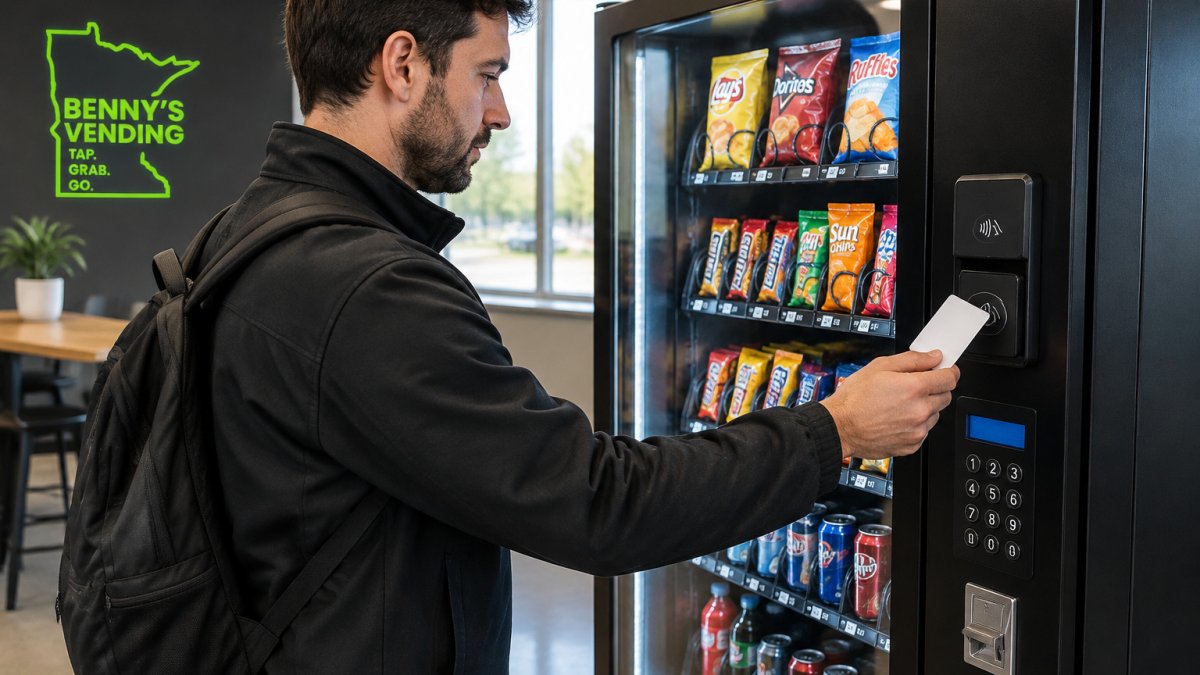
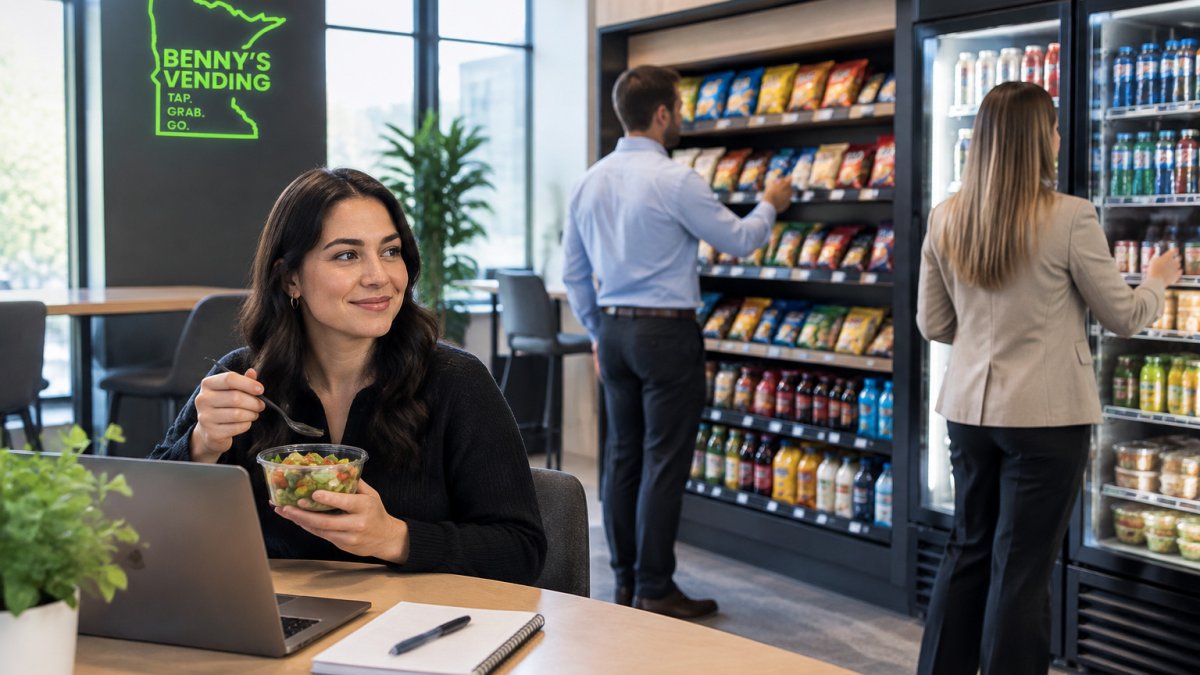
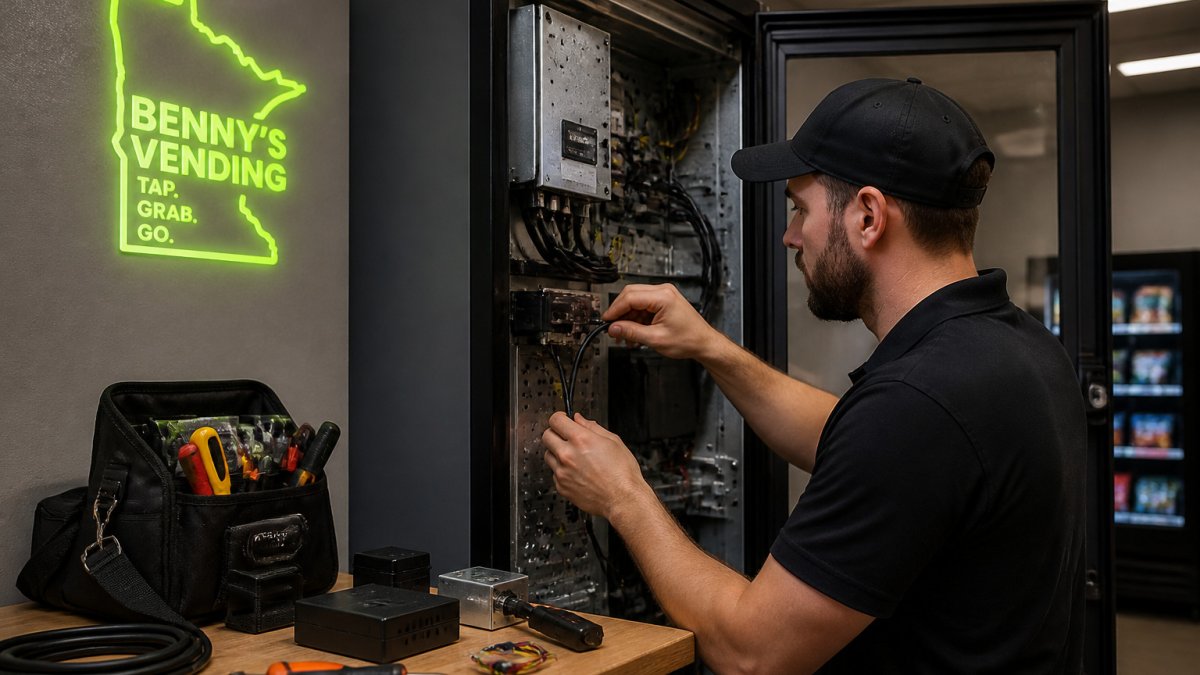
This is where Benny's Vending fits for Minnesota offices, warehouses, gyms, and apartment communities. Our AI-powered smart stores track inventory in real time, so restocking happens before shelves go empty, and contactless payment keeps the "tap, grab, and go" experience quick. We handle installation, maintenance, and restocking, and we offer zero cost and no contract options, so you can evaluate the service on its results rather than on a signed commitment.
Zero cost vending machine service options remove the equipment and service fees that keep most businesses out of vending, but they shift the decision to contract terms and provider quality. Read the exclusivity, term, and minimum-sales clauses before you sign anything. Benny's Vending builds AI-powered smart stores with real-time inventory tracking, contactless payment, and customizable displays, all installed and maintained by our team at zero cost and with no contract required. Request a machine from Benny's Vending and give your team a breakroom that stocks itself.
Frequently Asked Questions
What does a zero cost vending machine service include?
A zero cost vending machine service typically covers the machine itself, delivery, installation, restocking, and ongoing maintenance. Providers like Benny's Vending supply the equipment at no upfront charge and handle all service logistics. The provider owns the machine and recovers its investment through product sales. The U.S. vending machine market was valued at $21.9 billion in 2024 and is projected to reach $30.27 billion by 2033, reflecting how widespread these arrangements have become.
Are free vending machines really free for businesses?
The location pays nothing upfront for equipment or installation under most no-cost programs. Providers recover costs through product sales instead of charging the business. However, 'free' refers specifically to the equipment and service charges, not the products themselves. Some providers may require minimum sales volumes or specific contract lengths. Review vending machine service contract terms carefully to confirm what the zero cost label actually covers at your location.
What fees or contract terms should I check before choosing a vending service?
Look for equipment fees, installation charges, startup fees, and any hidden fees buried in the agreement. Confirm whether the contract includes exclusivity clauses, minimum sales requirements, or automatic renewal provisions. Ask about service response time guarantees and what happens if the machine underperforms. Vending machine service fees should be spelled out clearly, even when the headline offer is zero cost. Request a quote in writing before committing.
Can a business cancel a vending machine service contract?
Cancellation policies vary by provider. Some contracts allow cancellation with 30 to 90 days written notice, while others lock you in for multi-year terms with early termination penalties. Vending machine contract cancellation terms should be reviewed before signing. Ask specifically about notice periods, removal fees, and whether the provider requires you to pay back any equipment costs. A no-contract option gives you the most flexibility if your needs change.
Request a Machine
Comments