
How to Set Up a Micro Market Breakroom for Your Office
Quick Summary
A micro market breakroom is a self-service food and beverage area in an office, school or facility where people shop without a cashier. Shoppers pick items from open shelves and refrigerated coolers, then pay at a touch screen with a card or phone.
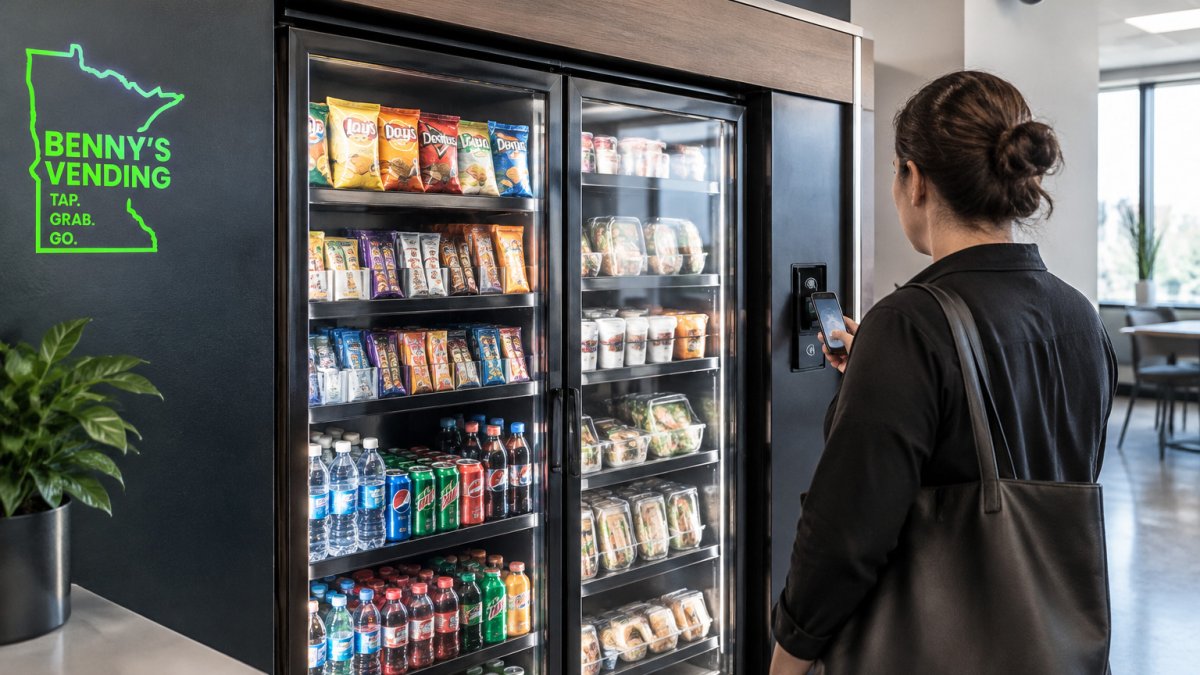
Open shelves and refrigerated coolers hold snacks, meals, drinks and fresh items in full view.
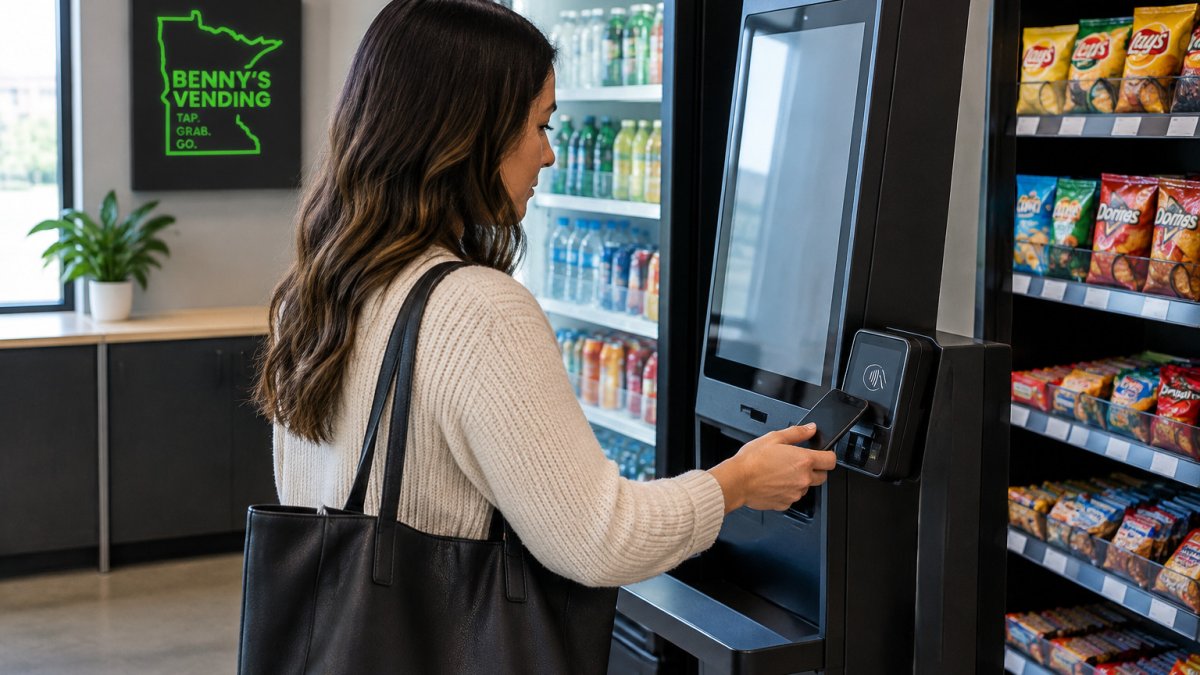
Shoppers scan a badge, card or app to open the market, then pay at the touch screen before leaving.
Industry revenue rose from $2.0 billion in 2020 to $5.4 billion in 2023, per the NAMA census.
About 22% of micro market inventory is fresh or healthy food, according to the NAMA census.
Check power circuits early, since shared circuits with breakroom appliances often cause launch delays.
Want a micro market in your breakroom?
Benny's Vending installs and restocks smart micro markets for offices across Minnesota.
Table of Contents
What a Micro Market Breakroom Is and How It Works
Last Updated: November 9, 2026

A micro market breakroom is a self-service food and beverage area in an office, school or facility, where people shop without a cashier. Shoppers pick items from open shelves and refrigerated coolers, then pay at a touch screen or with a card or phone. Micro markets have grown fast, with total industry revenue rising from $2.0 billion in 2020 to $5.4 billion in 2023 according to the NAMA industry census, 2023.
Micro markets are often seen as a step up from the old vending machine. The space can look more like a small grab-and-go store than a row of metal boxes.
Open shelves hold snacks, meals and drinks in full view.
Refrigerated coolers keep sandwiches, yogurt and cold drinks fresh.
Self-checkout lets people pay in seconds with a card or phone.
Self-Service Purchasing and Checkout
Shoppers in a micro market pick what they want, then check out on their own. Most systems use a touch screen or tablet at the exit, and many accept cards, phones and cashless payments.
Here is the typical flow:
The shopper scans a badge, card or app to open the market.
They take items off the shelves or out of the cooler.
They pay at the touch screen before they leave.
Unlike a standard vending machine, one micro market can offer a wide product mix in one place.
What You'll Find Inside: Food, Beverages and Fresh Options
Most micro markets carry the same kinds of items you would see in a small convenience store. The mix usually includes:
Chips, candy and cookies
Bottled water, soda, energy drinks and coffee
Sandwiches, wraps and salads in the cooler
Yogurt, fruit cups and other fresh snacks
Frozen meals in some setups
Healthy items are a growing share of many markets. The NAMA industry census, 2023 reports that about 22% of micro market inventory is fresh or healthy food. Many operators now stock more of these items because employees ask for them.
Micro Market Vending Benefits for Employees and Employers
Micro markets offer clear benefits for both the people who use them and the business that hosts them. For employees, the biggest gain is quick access to food and drinks without leaving the building. For employers, the space can improve breakroom comfort and reduce time spent on break runs.
Convenience: Staff get a snack or meal in a short walk.
Variety: Shelves hold many choices, not just a few machines' worth.
Morale: A well-stocked break spot gives people a place to recharge and talk.
Micro market vending benefits go beyond selection. Operators handle restocking and upkeep, so the host site does less work.
Micro Market Equipment Requirements and Space Planning
A micro market needs floor space, power, connectivity, and a clear plan for shelving and coolers. Before you commit, measure the room and think about traffic flow. People should be able to browse without blocking the door or the sink area.
Plan for:
Enough floor space for open shelving and one or more refrigerated units
Dedicated electrical circuits for coolers, lights, and the payment terminal
A stable internet connection for payment processing and inventory tracking
Room for a checkout screen near the exit
A layout that keeps the exit path clear for shoppers carrying items
Setup Requirements and Implementation Steps
Most micro market rollouts follow a predictable sequence. The exact steps vary by operator, but a common pattern looks like this:
Site survey. The operator measures the room, checks door widths and elevator access for equipment delivery, and confirms outlet locations and circuit capacity.
Power and connectivity check. Coolers and payment terminals need dedicated power; a shared circuit that also runs a microwave or coffee maker can trip breakers. Confirm Wi-Fi or wired internet reaches the checkout area.
Layout and equipment selection. The operator chooses shelving, cooler count, and checkout hardware based on headcount and shift patterns. A single-shift office of 50 people needs a very different footprint than a 24-hour facility with 300.
Installation. Equipment is delivered, assembled, and leveled. Coolers need time to reach temperature before stocking.
Stocking and planogram setup. Products are loaded to a planogram, and each item is entered into the inventory and payment system so checkout pricing is accurate.
Testing and launch. The operator runs test transactions, confirms payment processing, and trains any on-site contact on basic reporting and support contacts.
Watch out: skipping the power check is the most common cause of launch delays. A cooler that shares a circuit with breakroom appliances will trip breakers during peak hours, and the fix usually means an electrician visit before the market can open.
Our smart pantry format fits well in a typical office breakroom. The Stockwell 2.0 unit is built for self-service stocking and installation, while the Micromart smart pantry format suits offices that want a compact setup.
Office Breakroom Design Trends 2026 for Micro Markets
Office breakrooms are changing. Many workplaces now want a space that feels like a small café or market rather than a plain kitchen corner.
Current design trends include:
Open shelving with clear labels and easy-to-read prices
Warm lighting and seating near the market area
Fresh and healthy options placed at eye level
Clean, minimal fixtures that match the rest of the office
Matching the breakroom to the brand of the workplace helps people feel welcome. It also makes the space easier to keep clean.
Costs, Security and Measuring Results
Costs depend on equipment, product mix, software, and how much service the site needs. Pricing depends on quantity, delivery, and setup, so we recommend asking for a quote based on your site's needs. You can compare the upfront and recurring expenses with smart vending machine installation cost guidance and check whether the investment makes sense with this cost and ROI guide.
How Micro Market Costs Usually Work
Most micro market arrangements fall into one of two models. In an operator-owned model, the operator pays for equipment and inventory and earns revenue from product sales; the host site typically provides space and power at no direct cost. In a site-owned model, the business buys the equipment and either self-stocks or contracts a service provider for restocking and maintenance. A common pattern is a hybrid: the operator supplies hardware and software, and the site shares in revenue or pays a service fee. Because the hybrid model can extend beyond snacks to beverages, the same decisions about equipment, stocking, and service can shape an office coffee program with Humm Coffee Roasters.
Factors that move pricing include:
Number and type of coolers and shelving units
Payment terminal and software licensing
Delivery frequency and route distance
Product mix, including fresh items with shorter shelf life
Service level for restocking, cleaning, and maintenance
Food Safety, Security, and Loss Prevention
Fresh food raises food safety obligations. Coolers must hold safe temperatures, and staff or operators should check and log temperatures on a schedule. Expired items need a clear pull-and-dispose routine. Payment security matters too: modern terminals use encrypted card processing, and shoppers should never enter card details on an unsecured device.
Loss prevention combines access control, camera coverage, and inventory discipline:
Badge, card, or app access limits the market to authorized users
Camera coverage at the entrance and checkout deters theft
Regular inventory counts reveal shrink patterns by product and shift
Planogram discipline makes missing items easier to spot
Watch out: treating shrink as purely a theft problem hides the bigger cause. Expired fresh food and mispriced items often account for more loss than theft, so review waste and pricing data alongside inventory counts.
Measuring Performance and Return on Investment
A micro market is easier to justify when you track a few measurable indicators:
Transactions and sales per day show whether usage matches headcount
Product waste and expiration pulls reveal whether the mix is right
Top and bottom sellers guide planogram changes
Usage by shift shows whether late or early crews are served
Employee feedback captures demand for items the data misses
Review these numbers with your operator on a schedule, and adjust the product mix rather than accepting a static planogram. A market that is measured and tuned tends to hold usage better than one that is stocked and forgotten.
Watch out: placing a market in a low-traffic corner can leave staff with no reason to visit. Put it where people already walk.
The article sets out the main factors and measures to weigh when assessing a micro market's cost and performance.
Measure | What it tracks | Why it matters |
Transactions and sales per day | Usage against headcount | Shows whether demand matches the crowd |
Product waste and expiration pulls | Unsold or expired stock | Reveals whether the product mix is right |
Top and bottom sellers | Best and weakest items | Guides planogram changes |
Usage by shift | Activity across shifts | Shows whether late or early crews are served |
Employee feedback | Requested items | Captures demand the data misses |
Booking Your Micro Market Consultation With Benny's Vending
Ready to see a micro market in your office? Benny's Vending handles installation, setup, maintenance and restocking, so your team can focus on work. Our shipping and setup policy explains how we handle delivery and installation at your location.
Request a machine today and we will walk through the space, the product mix and the costs with you.
Frequently Asked Questions
How does a micro market differ from traditional vending machines?
A traditional vending machine is a closed cabinet that dispenses one item per selection, while a micro market is an open-shelf, cooler-based room where shoppers browse, pick multiple items and pay at a single self-checkout point. Micro markets typically offer a wider mix of fresh food, meals and beverages, and they can be arranged to fit a break area's layout rather than a single machine footprint. Benny's Vending can explain which format suits your space; pricing depends on quantity, delivery schedule and equipment, so request a quote for current figures.
What technology is required to operate a micro market?
A micro market needs a self-checkout terminal that accepts cashless payment, such as card or mobile payment, along with inventory and sales tracking software. Coolers and shelving keep product at proper temperatures and in view. Benny's Vending uses real-time inventory tracking and contactless payment systems. Ask your provider which payment methods and reporting tools are included.
Do micro markets require staff to operate?
Shoppers run the market themselves, so there is no cashier on site. The operator handles restocking, maintenance and inventory, which means employees do not need to manage the stock. Benny's Vending handles installation, maintenance and restocking, so your team simply uses the space. Confirm the service schedule and response times with your provider before signing on.

Comments